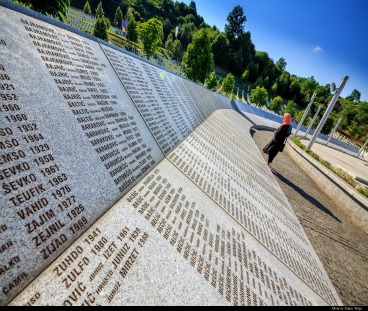
Mr. Speaker, I want to bring to the attention of my colleagues House Resolution 199, regarding the 1995 massacre at Srebrenica in eastern Bosnian-Herzegovina. In July, ten years will have passed since thousands of Bosniaks perished in what was the worst atrocity committed during the three-and-a-half years of conflict in Bosnia. This was an absolute fiasco by the international community, eroding its credibility and principles. Those of us who worked together at the time in urging a more decisive international response can remember the horror associated with that conflict.
Many may ask: why do this? Why focus on what happened ten years ago in a region that we are encouraging to look forward to a future that includes further European integration? I believe it is impossible to look forward without acknowledging the past and what really happened at Srebrenica. We have many lessons to learn from the past.
First, the very fact that many of those responsible for the Srebrenica massacre–especially Ratko Mladic and Radovan Karadzic and others, not only have evaded justice in The Hague but may be receiving protection and are held almost as folk heroes by some indicates that the past has not been fully understood. Hundreds of people currently holding positions of responsibility are only now being investigated for possible connections to the massacre. Clearly the myths and propaganda originally used to justify a slaughter still hold sway in the minds of too many people.
Second, the international community must learn not to repeat the mistakes it made with horrible consequences in 1995. Some lessons have been learned. For the first time since World War II, for example, an international tribunal was created to prosecute those responsible for war crimes, crimes against humanity and genocide. That body has borne some results, though its task is not complete.
Intervention in Bosnia-Herzegovina was not some reckless act, as some suggest, but a needed response made increasingly difficult by unnecessary delay. Mutual congratulations will undoubtedly come later this year when commemorating the ten year anniversary of the Dayton Agreement. We would do well, however, to recall that it was the simple shame of allowing thousands to be massacred within one of the international community’s officially designated “safe areas” that finally motivated serious consideration of action against the brazen thugs responsible for these crimes. Unfortunately, it took additional atrocities before effective action was taken.
It is also helpful to listen to some of the words spoken in the aftermath of the Srebrenica massacre. For example, 27 non-governmental organizations, including religious and humanitarian organizations not usually inclined to support the use of force, as well as Muslim and Jewish organizations not known for taking common stands, issued a powerful statement:
Bosnia is not a faraway land of no concern to our “national interest.” At stake is the global commitment to fundamental human values, the right not to be killed because of one’s religious or ethnic heritage, and the right of civilians not to be targeted by combatants.
At about the same time, the U.N.’s rapporteur for human rights in the former Yugoslavia, former Polish Prime Minister Tadeusz Mazowiezki, explained why he could no longer ‘‘continue to participate in the pretense of the protection of human rights’’ and chose to resign in response to the events at Srebrenica. Known as a thoughtful, principled man, he said:
One cannot speak about the protection of human rights with credibility when one is confronted with the lack of consistency and courage displayed by the international community and its leaders. . . . Crimes have been committed with swiftness and brutality and by contrast the response of the international community has been slow and ineffectual.
If, when listening to these words from ten years ago, we think of subsequent events including Darfur today, we realize how little we have indeed learned.
In Bosnia-Herzegovina we also produced examples of the best in humanity, people in the international community, aid workers, soldiers, diplomats, journalists, monitors and advocates, who risked and sometimes gave their lives to prevent further loss of life. I particularly mention in this connection the American negotiators Robert Frasure, Joseph Kruzel, and Nelson Drew who died while traveling Bosnia’s dangerous, war-torn roads. They deserve our gratitude for the efforts to restore peace in Bosnia-Herzegovina.
Finally, Mr. Speaker, we cannot forget the memory of the victims of Srebrenica and those who survived, but were traumatized by the debacle at Srebrenica. Many continue to wonder about the ultimate fate of the missing, even as new mass graves have been unearthed in northeastern Bosnia-Herzegovina. For these people, ten years is not long ago, and recognizing the pain and anguish they experienced may help bring closure for them. Some of these victims, I should add, have come to our country as refugees and are now Americans. They will no doubt be remembering the tragic events at Srebrenica ten years ago.
I will not detail here the almost unspeakable horrors that were part of the massacre at Srebrenica in July 1995. Some of the events are mentioned in House Resolution 199. Mr. Speaker, I hope that my colleagues will give this measure their serious consideration and active support.