
-
hearing
Soviet Jewry: H. Con. Res. 63
Thursday, June 23, 1983This joint hearing by the Committee on Foreign Affairs, Subcommittee on Human Rights and International Organizations, and the Commission on Security and Cooperation in Europe examined the plight of Jews in the Soviet Union. Moscow's heightened campaign of hatred against its own citizens, in flagrant disregard of international law, was identified as a factor in whether the United States should enter into any further agreements with the Soviet Union, especially ones which involve United States security. Witnesses testifying at this hearing expressed their concerns about the continued persecution and harassment of the Jewish community in the Soviet Union. The repressive policies instituted by the Soviet regime to destroy Jewish culture, despite its commitment to the human rights terms agreed upon during the Helsinki Final Act, were outlined.
-
hearing
IMPLEMENTATION OF THE HELSINKI ACCORDS VOL. IV - REPORTS ON SOVIET REPRESSION AND THE BELGRADE CONFERENCE
Sunday, June 05, 1977In light of first anniversary of the creation of the Commission on Security and Cooperation in Europe, this hearing focused on the work and the plight of courageous individuals who utilized the Helsinki accords as instruments for advancing international respect for human rights. In particular, the hearing delved into the case of Anatoly Shcharansky, one of the most courageous spokesmen of human rights in the U.S.S.R., faces treason charges as groundless as they are ominous. The Soviet decision to hold a show trial for Shcharansky with phony evidence and counterfeit witnesses combined with the earlier arrest of members of Helsinki monitoring groups in Russia, Ukraine, and most recently, in Georgia, were in violation of the Helsinki accords.
-
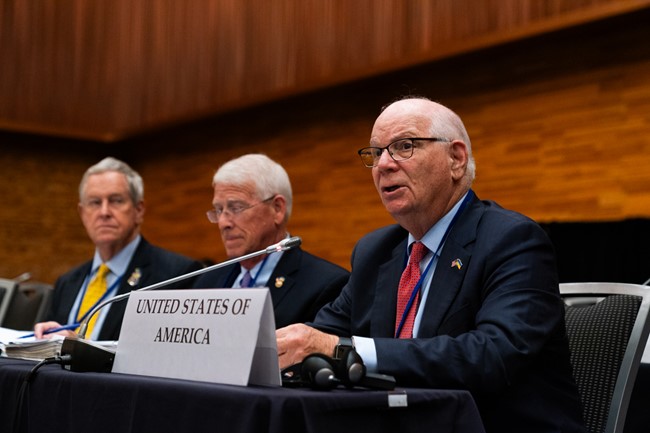
TwitterParliamentary diplomacy is an important tool in US foreign policy,...Parliamentary diplomacy is an important tool in US foreign policy, and @HelsinkiComm members like @SenatorCardin,… t.co/78cILxFhNW
-
helsinki commission
Justice at Home
Promoting human rights, good governance, and anti-corruption abroad can only be possible if the United States lives up to its values at home. By signing the Helsinki Final Act, the United States committed to respecting human rights and fundamental freedoms, even under the most challenging circumstances. However, like other OSCE participating States, the United States sometimes struggles to foster racial and religious equity, counter hate and discrimination, defend fundamental freedoms, and hold those in positions of authority accountable for their actions. The Helsinki Commission works to ensure that U.S. practices align with the country’s international commitments and that the United States remains responsive to legitimate concerns raised in the OSCE context, including about the death penalty, use of force by law enforcement, racial and religious profiling, and other criminal justice practices; the conduct of elections; and the status and treatment of detainees at Guantanamo Bay and elsewhere.
-
helsinki commission
Justice Overseas
Human rights within states are crucial to security among states. Prioritizing respect for human rights and fundamental freedoms, defending the principles of liberty, and encouraging tolerance within societies must be at the forefront of America's foreign policy agenda. Peace, security, and prosperity cannot be sustained if national governments repress their citizens, stifle their media, or imprison members of the political opposition. Authoritarian regimes become increasingly unstable as citizens chafe under the bonds of persecution and violence, and pose a danger not only to their citizens, but also to neighboring nations. The Helsinki Commission strives to ensure that the protection of human rights and defense of democratic values are central to U.S. foreign policy; that they are applied consistently in U.S. relations with other countries; that violations of Helsinki provisions are given full consideration in U.S. policymaking; and that the United States holds those who repress their citizens accountable for their actions. This includes battling corruption; protecting the fundamental freedoms of all people, especially those who historically have been persecuted and marginalized; promoting the sustainable management of resources; and balancing national security interests with respect for human rights to achieve long-term positive outcomes rather than short-term gains.
Name
Anti-Semitism
In response to anti-Semitic violence in Western Europe and the broader OSCE region in the early 2000s, members of the U.S. Helsinki Commission pushed for OSCE participating States to recognize anti-Semitism and anti-Jewish violence as a unique region-wide phenomena, given European history, especially the Holocaust. Helsinki Commission-led efforts include annual hearings, legislation within the U.S. Congress, and resolutions adopted by the OSCE Parliamentary Assembly (OSCE PA) on combating anti-Semitism.
Other OSCE initiatives supported by Helsinki Commissioners include the seminal 2004 Berlin Conference, where OSCE participating States pledged to implement the landmark "Berlin Declaration" against anti-Semitism, and the follow-on 2014 “High-Level Commemorative Event and Civil Society Forum on the 10th Anniversary of the OSCE’s Berlin Conference on Anti-Semitism.” Commission work on these issues also helped spur the annual appointment by successive OSCE Chairs-in-Office, since 2004, of three Personal Representatives to promote tolerance, including a Personal Representative on Anti-Semitism; the creation of a Tolerance and Non-Discrimination Office, which includes a specific focus on anti-Semitism housed in OSCE’s Warsaw-based Office of Human Rights and Democratic Institutions (ODIHR); and more than thirty high-level OSCE and OSCE PA meetings and other events on anti-Semitism and other forms of intolerance.
Additionally, Commissioners have led efforts in the United States to include anti-Semitic incidents in the annual State Department International Religious Freedom Reports and Country Reports on Human Rights, and to create the position of the U.S. Special Envoy on Anti-Semitism within the State Department. Following attacks in Paris and Copenhagen in 2015 where Jewish institutions were targeted, Commissioners have supported OSCE and other European efforts to combat anti-Semitism, including legislation calling for increased security for the Jewish community, funds for civil society coalitions to combat hate, and a U.S.-EU Joint Action Plan to combat prejudice and discrimination that would include a specific focus on anti-Semitism.
Staff Contact: Mischa Thompson, senior policy advisor