Coronavirus in the OSCE Region
Friday, October 30, 2020, 4:00 am
Image
Pandemic Policy
By Emma Derr, Max Kampelman Fellow
A novel coronavirus was first identified in Wuhan, China in December 2019. Termed COVID-19, the disease spread rapidly around the globe. As of October 2020, 1.18 million people have died from COVID-19, and over 227,000 of these deaths have occurred in the United States. COVID-19 is one of the most devastating public health crises since the Spanish Flu of 1918. From hospital beds to protective gear, governments across the world face significant challenges in combating its morbidity and death rates. In addition to the domestic coronavirus policies implemented at the national level, multilateral organizations such as the Organization for Security and Cooperation in Europe (OSCE) have taken their own steps to curb the vast negative impacts of the novel coronavirus.Examples of Coronavirus Policy Responses across the OSCE Region
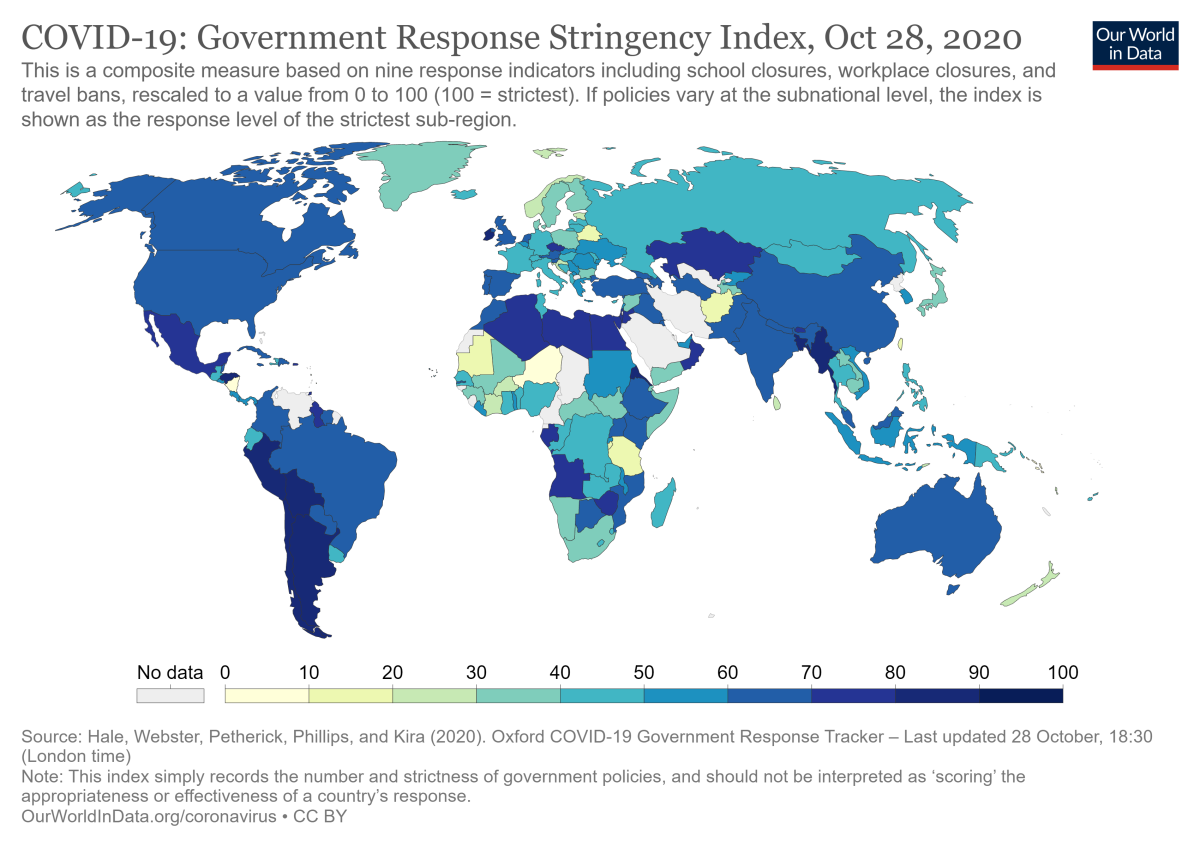
Countries in the OSCE region have developed a wide variety of policies to combat the significant public health, political, and economic challenges caused by the coronavirus. As the number of cases has surged or declined in various countries, coronavirus restrictions are changing on a weekly basis. In most countries, policies exist at a national level, and many countries have also imposed regional restrictions. In the United States, state and local authorities impose their own restrictions. The varying responses of the United States, Sweden, France, and Turkmenistan illustrate the many coronavirus policy differences that exist in the OSCE region. The scientific publication "Our World in Data," in collaboration with the University of Oxford, created a "Government Response Stringency Index" using nine response indicators, including school closures and travel bans. With 100 as the strictest ranking, the index currently ranks the United State at 62.5, France at 46.76, and Sweden at 37.04. Turkmenistan is not on the index.
Image
OSCE Action
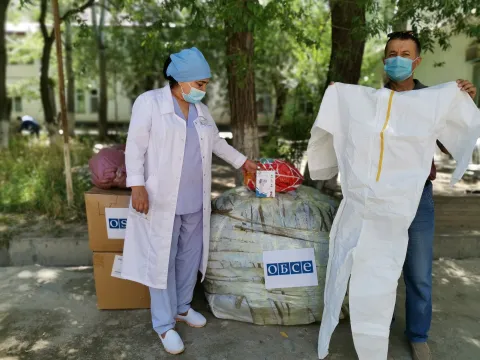
The Organization for Security and Cooperation in Europe (OSCE) is the world's largest regional security organization with 57 participating States. Leaders of OSCE institutions and offices have stated their continuing commitments to OSCE principles and stress the importance of unity and solidarity as its nations fight to control the pandemic. "Now is the time for unity. The COVID-19 virus does not distinguish between peoples or countries; its threat is universal. This underscores that security is common, comprehensive and indivisible," said the Chair of the OSCE Permanent Council Igli Hasani and his colleagues in a letter earlier this year. The OSCE seeks to provide leadership through guidelines and policy recommendations that address the challenges presented by the novel coronavirus. The organization has also been active in examining the economic, environmental, and security implications of the coronavirus across the OSCE region. "In today's highly interconnected world, it is necessary to have strong solidarity and a cooperative approach at all levels: community, state, regional, and global," stated Vuk Zugic, OSCE Coordinator of Economic and Environmental Activities. Minority Groups and Vulnerable Populations On the Helsinki on the Hill podcast "Communities at Risk," Ambassador Lamberto Zannier, the former OSCE High Commissioner on National Minorities and a current OSCE PA High-Level Expert, spoke about providing protection for the most vulnerable during this health crisis. "We felt that the issue of protecting the diversity of the society and ensuring that all social groups are included in the policies, and there is an equal treatment for all, was not at the forefront of the concerns of many governments," he said. "We started to see problems of discrimination. We started to see problems with hate speech. We started seeing problems with access of some of the population to basic services." In March, as OSCE High Commissioner on National Minorities, Zannier released recommendations for short-term responses to COVID-19 to support social cohesion in OSCE states, and in April, the HCNM released a full set of policy recommendations that call on countries to take into account diversity when implementing state emergency measures, such as providing public services and media communications in minority languages. Voting and Elections The OSCE Office for Democratic Institutions and Human Rights (ODIHR) is mandated to address issues related to democracy, human rights, and rule of law, including freedom of the press, freedom of movement, and democratic elections. ODIHR released a report in October outlining best alternative voting practices in the context of COVID-19, focusing on secrecy, equality, and universality. Human Trafficking ODIHR also conducted an empirical survey of survivors of human trafficking and issued a report in June that examined the impact of COVID-19 on human trafficking trends and recommended how OSCE states could respond. According to OSCE PA Special Representative on Trafficking in Persons and former Helsinki Commission Chair Rep. Chris Smith, "The COVID-19 pandemic has increased the vulnerability of children to becoming victims of trafficking and sexual exploitation. Today, with most schools closed, children are spending more of their time online where they are vulnerable to being groomed by sexual predators and lured into trafficking situations. One way we can fight this and protect our children now is by education to keep them safe online and by developing age-appropriate training tools for children, parents and educators." Parliamentary Diplomacy The OSCE Parliamentary Assembly (OSCE PA) has hosted several webinars focused on the effects of the coronavirus on human rights and democracy. The webinar titled "COVID's impact on conflicts in the OSCE region" addressed obstacles to conflict resolution, humanitarian aid efforts, and implementation of the fundamental principles agreed to under the Helsinki Final Act. Helsinki Commissioner and Chair of the OSCE PA General Committee on Political Affairs and Security Rep. Richard Hudson attended the discussion and stated his concern over "the COVID-19 pandemic and its potential to further inflame existing conflicts in the OSCE area or potentially generate new ones." He said it was important for the Parliamentary Assembly to stay informed on the OSCE's role in the conflict cycle, specifically in Ukraine and Georgia. Other speakers emphasized his message and noted that people in conflict zones are on one of the most dangerous frontlines of the pandemic. In May, the OSCE PA hosted a webinar titled "Respecting Human Rights and Maintaining Democratic Control During States of Emergency." In his comments, Helsinki Commission Chairman Rep. Alcee L. Hastings (FL-20) emphasized the importance of protecting fundamental freedoms. "I am sorry, but not surprised that some governments have taken the need for emergency measures as an opportunity for repressive measures," he stated. "Hungary is the only OSCE participating State that does not have a sunset clause for the expiration of its emergency measures or requiring parliamentary approval for an extension. Parliamentary oversight is absolutely essential, especially when governments seek to exercise extraordinary powers." During the webinar, Sen. Ben Cardin (MD), Helsinki Commission Ranking Member and the OSCE Parliamentary Assembly Special Representative on Anti-Semitism, Racism, and Intolerance, also addressed concerning aspects of COVID-19 emergency responses. "Emergency provisions which restrict freedom of speech or freedom of the media are especially concerning and may actually undermine our efforts to address this health emergency. We need to ensure that journalists, medical professionals, scientists and others can provide the public with information we need to battle COVID," he said. OSCE Field Missions OSCE field missions have been actively adapting to support host countries' needs during this pandemic. Since April, several missions have helped to provide medical supplies and equipment to their host countries. The OSCE Presence in Albania, a field operation that cooperates with Albania's Border and Migration Police, donated medical supplies to Albania's Border Police in May. The team also visited border crossing points to assess existing protocols. The OSCE Programme Office in Dushanbe provided protective gear and sanitizing supplies to its partners in Tajikistan, and the OSCE mission to Montenegro delivered food and hygiene products to support the country's Red Cross.
Image
Media contact
Email csce.press@mail.house.gov
Phone (202) 225-1901
Relevant Countries
Leadership